Young Ju, Ph.D.
The consumption of soybeans and soybean products is increasing due to the popularity of plant-based diets and their potential health benefits even though scientific evidence of those benefits is moderate and still evolving.
Soybeans and Soybean Products (1, 2)
Soybeans are annual legumes of the pea family. Originating in China, soybeans have been cultivated for over 5,000 years. They were introduced to America in the 19th century; since the 1940s, they have become one of the most important economic crops in the U.S. Currently, more than 90% of soybeans processed in the U.S. are to meet the demand for animal feed and oil (3).
The nutritional composition of soybeans varies depending on variety, geographical location, climate, and farming practices. Typically, dry soybeans contain 40% protein (with all essential amino acids), 20% lipids (with a high level of unsaturated fatty acids), 10% dietary fiber, vitamins, and minerals. Soybeans also contain many non-nutritional components, including isoflavones (plant estrogen, also called phytoestrogen).
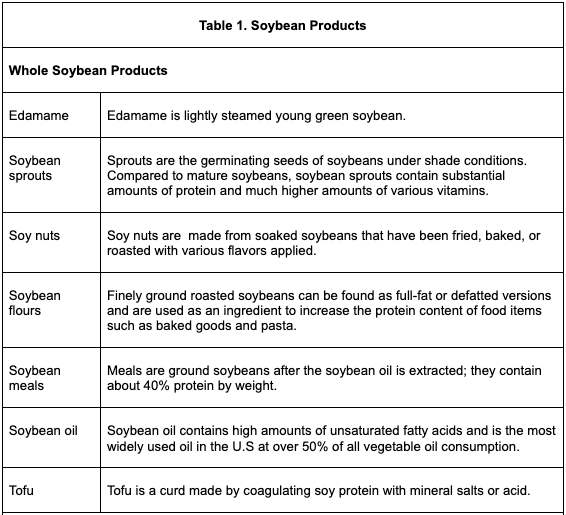
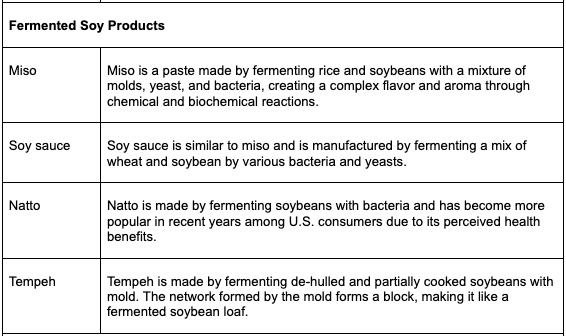
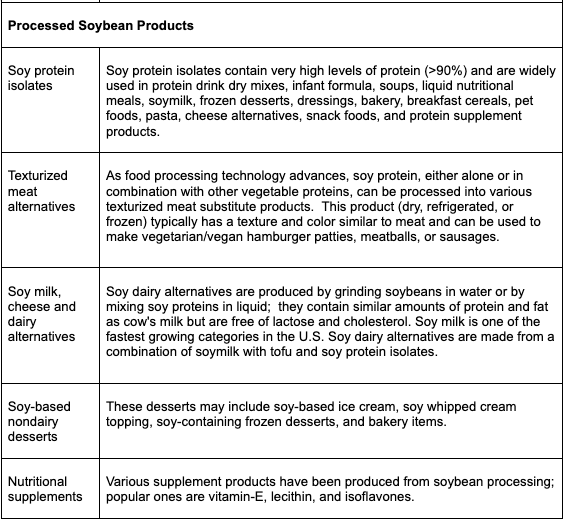
In the U.S., soybean consumption as food in the U.S. is still low compared to Asian countries, but it is growing due to increased interest in plant-based diets and other environmental reasons. Besides whole soybean products, other derivatives are available (Table 1) including fermented products which are high in probiotic bacteria and processed products widely used in food processing.
Research Findings on Potential Health Benefits
A substantial amount of research has examined the effects of soybeans and soy bioactive components on health conditions, including cardiovascular disease, type 2 diabetes, intestinal health, cancer, osteoporosis, menopause, cognitive function, and thyroid function etc. Studies have reported mixed and moderate results. Several recent studies are reviewed in this section with the following implications:
Cardiovascular disease (4, 5, 6): In general, habitual consumption of soybean food and soy products is associated with reduced risk of cardiovascular disease as it lowers LDL-cholesterol (bad cholesterol) levels and blood pressure, improves vascular function (to regulate blood flow and pressure), and lowers cardiovascular mortality.
Intestinal health (7, 8): Fermented soy products positively impact the gut microbiota by increasing beneficial probiotic bacteria and enhancing the production of beneficial metabolites including short-chain fatty acids. Studies also suggest that these effects can improve gut barrier function which functions as a first line defense mechanism against harmful substances and organisms. These effects further can modulate the immune system and have been associated with various health benefits, such as improved digestion and a lower risk of certain diseases.
Type 2 diabetes (4, 6, 9): Association studies found that consumption of soy foods and soy isoflavones can lower risk of type 2 diabetes. Clinical trials showed moderately improved metabolic markers, including HbA1c, blood lipid profile, and inflammatory markers.
Potential Adverse Effects (10, 11)
Soy protein is one of the top 8 allergens. Individuals with soybean allergy should avoid any food containing soybeans. Fermented soy products may be better tolerated for some people with sensitivity.
Soy protein isolates or high-dose isoflavone supplements may cause bloating, gas, mild abdominal discomfort, constipation, and loose stools.
High soy intake may interfere with the absorption of thyroid hormone medication. It’s recommended to take thyroid medication on an empty stomach and avoid soy for a few hours before and after.
High-dose isoflavone supplements may stimulate estrogen-receptor positive breast cancer, which subtype of breast cancer is sensitive to estrogen and estrogen-like substances in mice and rat studies. Whole soy foods and isoflavones contained in food products are safe.
Summary
Soybeans and their products are food sources with high nutritional values and a long history of use. If you follow a plant-based diet, soybean food products can be good alternatives to animal proteins. When you add soybeans into your diet, try to choose whole or minimally processed soy foods, instead of dietary supplements. Also try to consume a variety of legumes, instead of just relying on soybeans.

Dr. Young Ju is a Ph.D and Associate Professor of Human Nutrition, Foods, and Exercise at Virginia Tech.
References
Messina. “Legumes and soybeans: overview of their nutritional profiles and health effects.” Am J Clin Nutr. 1999, 70(3 Suppl):439S.
Liu. “Soybean: Overview” Reference Module in Food Science 2016 https://doi.org/10.1016/B978-0-08-100596-5.00028-7
U.S. Department of Agriculture Economic Research Service https://www.ers.usda.gov/data-products/charts-of-note/chart-detail?chartId=112861
Akesson. “Legume consumption in adults and risk of cardiovascular disease and type 2 diabetes: a systematic review and meta-analysis.” Food Nutr Res. 2023, 30:67.
Naghshi et al. “Soy isoflavone intake and risk of cardiovascular disease in adults: A systematic review and dose-response meta-analysis of prospective cohort studies.” Crit Rev Food Sci Nutr. 2024, 64(18):6087.
Rizzo. “Soy-based tempeh as a functional food: Evidence for human health and future perspective.” Front Biosci (Elite Ed). 2024, 16(1):3.
Chang et al. “Substituting animal protein with black soymilk reduces advanced glycation end product level and improve gut microbiota composition in obese prediabetic individuals: a randomized crossover intervention trial.” Food Funct. 2025, 16(1):195.
Wang et al. “Soy isoflavone-specific biotransformation product S-equol in the colon: physiological functions, transformation mechanisms, and metabolic regulatory pathways.” Crit Rev Food Sci Nutr. 2024, 64(16):5462.
Hashimoto et al. “Fermented soybean foods and diabetes.” J Diabetes Investig. 2023, 14(12):1329.
NIH, National Center for Complementary and Integrative Health. “Soy” https://www.nccih.nih.gov/health/soy#:~:text=Side%20effects%20of%20soy%20may,%2C%20dangerously%20high%20blood%20pressure).
Mayo Clinic. “Soy: Does it worsen hypothyroidism?”https://www.mayoclinic.org/diseases-conditions/hypothyroidism/expert-answers/hyperthyroidism/faq-20058188
People with any health problems should talk to their healthcare providers. This information is provided for your reference, and you use at your own risk; you should rely on your medical professional for medical advice.