Take A Deep Breath And Relax: Abdominal Breathing & Your Health
Young Ju, Ph.D.
The very breath you take can contribute to your health and well-being. We are born as abdominal breathers; however, as we get older, we gradually become chest breathers due to many factors. These can be stressors, poor posture, or even tightening the stomach for a trimmer waistline, etc. Controlled breathing refers to the conscious regulation of breathing. There is a substantial amount of research that shows the benefits of learning to control your breathing so that you can use abdominal breathing instead of shallow chest breathing. This article describes these benefits to people with various health conditions and to active people, including tennis players as well as how to learn to control your breathing.
Abdominal Breathing vs. Chest Breathing
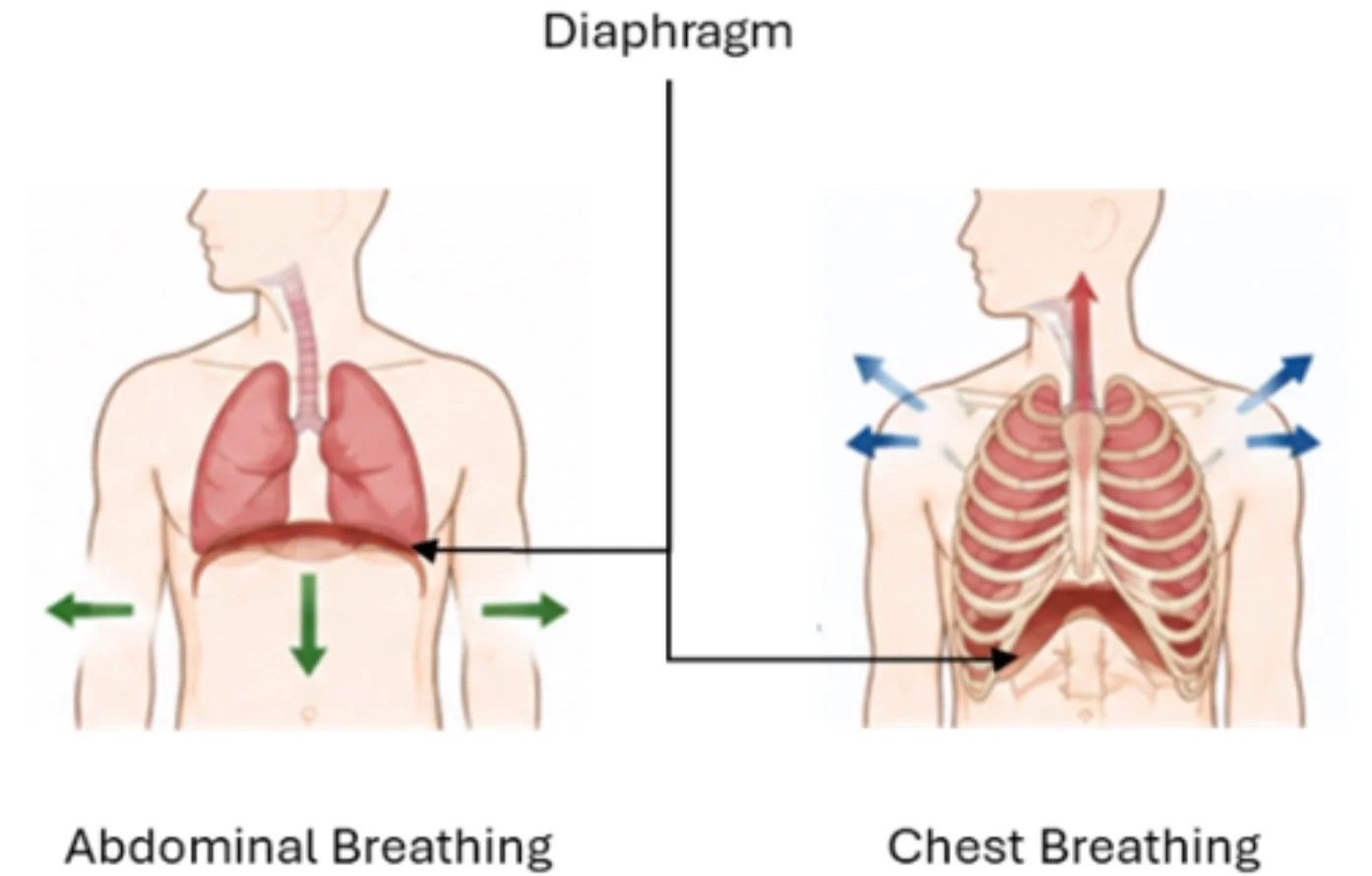
Abdominal (diaphragmatic) breathing is one type of controlled breathing. Abdominal breathing involves the efficient use of your diaphragm. The diaphragm is the dome-shaped muscle that separates the chest cavity from the abdominal cavity. It is one of the major breathing muscles and plays a vital role in breathing. When you breathe using your diaphragm, it contracts downward and your abdomen expands outward. Abdominal breathing can be characterized as deep and slow breathing with more air. It also triggers the parasympathetic nervous system (“rest and digest”).
Chest (thoracic) breathing relies on your neck and upper rib muscles. Your shoulders and chest rise and expand as you inhale. Chest breathing can be characterized as shallow and rapid breathing with less air. It triggers the sympathetic nervous system (“fight-or-flight”).
Health Benefits of Abdominal Breathing
Abdominal breathing is linked to multiple physical and mental benefits including improved cerebrospinal fluid movement, reduced exercise-induced oxidative stress, improved sleep quality, reduced digestive disorders such as acid reflux and gastroesophageal reflux disease, lowered pain perception, and good postural control (1).
Stress reduction and mental well-being (2, 3): Abdominal breathing reduces both physiological and psychological stress markers by improving the parasympathetic nervous system and reducing the sympathetic nervous system, resulting in:
o Lowered salivary cortisol (a stress hormone)
o Reduced self-reported stress and anxiety scores
o Improved quality of life
o Improved sleep quality
Cardiovascular benefits (3, 4, 5):
o Reduced heart rate
o Lowered blood pressure
Lung function (4, 6):
o Reduced dyspnea
o Increased oxygen levels in the blood
o Improved breathing efficiency
o Improved exercise tolerance and capacity
o Aid in the release of waste from the lungs
Gastroesophageal reflux disease (4, 7):
o Increased lower esophageal sphincter pressure
o Reduced reflux episodes
o Decreased reliance on medication in some patients
Cognitive function and brain health (6, 8):
o Enhanced attention
o Improved executive function
o Improved emotional regulation
o Enhanced stress resilience
Physical function and exercise tolerance/performance (9, 10):
o Improved muscle function during exercise and prevented strains
o Improved balance and mobility
o Reduced muscle fatigue
o Improved exercise tolerance
o Improved core muscle stability
Breathing and Exercise
At rest, the diaphragm is your primary breathing muscle. During exercise, the diaphragm still contributes to breathing, but as breathing demand and exercise intensity increase, breathing becomes deeper and faster, involving additional muscles to help ventilation (11). Abdominal breathing is ideal for low-to-moderate-intensity exercise (e.g., walking, hiking, leisure cycling, moderate jogging, yoga, and qigong/taichi, etc.). Abdominal breathing is also crucial for stabilizing the core during heavy-resistance training (e.g., heavy lifting or weight squats). For very high-intensity cardio, abdominal breathing may not be ideal because the body requires chest breathing to push in and out as fast as possible (12).
During a tennis match which may feature both moderate- and high-intensity cardio, abdominal breathing could help oxygen intake, help engage your core for power, and help you to calm down. For example, you could use abdominal breathing to reset your breathing pattern between rallies, while during the rallies, you could consciously inhale on the bounce and exhale on the hit (13).
How to Practice Abdominal Breathing (14, 15)
Many of us may have difficulty with abdominal breathing because we typically use chest breathing. Practice makes it easier.
Lie down on your back with knees bent (or with a pillow under your knees), or you can just sit comfortably and relax your head and neck.
Place one hand on your upper chest and the other hand on your belly.
Inhale slowly through nose for ~2-4 seconds and then exhale slowly through mouth (or pursed lips) for ~4-8 seconds), letting your abdomen expand outward while your chest remains as still as possible.
Practice regularly for five to ten minutes several times a day.
Summary
Breathing is an essential part of life. Abdominal breathing could provide benefits across physical and mental performance and everyday wellness. In sports, it could regulate heart rate, prevent muscle tension, maximize power, and improve psychological readiness. Practice controlled breathing using your diaphragm to take deep breaths.

Dr. Young Ju is a Ph.D and Associate Professor of Human Nutrition, Foods, and Exercise at Virginia Tech.
References
Vranich et al. “The breathing IQ: an anthropometric index of diaphragmatic breathing efficiency.” Front. Physiol. 2025, 15:1394109.
Hopper et al. “Effectiveness of diaphragmatic breathing for reducing physiological and psychological stress in adults: a quantitative systematic review.” JBI Database System Rev Implement Rep. 2019, 17(9):1855.
Shao et al. “The effect of slow-paced breathing on cardiovascular and emotion functions: A meta-analysis and systematic review.” Mindfulness 2024, 15:1.
Kwon et al. “The health effects of diaphragmatic breathing: A systematic review.” Complement Ther Med. 2026, 96:103317.
Laborde et al. “Effects of voluntary slow breathing on heart rate and heart rate variability: A systematic review and a neta-analysis.” Neurosci Biobehav Rev. 2022, 138:104711.
Song et al. “Effects of 12 weeks of head-down strong abdominal breathing training on gait and cognitive function in patients with chronic obstructive pulmonary disease.” Int J Chron Obstruct Pulmon Dis. 2025, 20:1347.
Abureesh et al. “Efficacy and safety of diaphragmatic breathing exercises for gastroesophageal reflux disease: A systematic review and meta-analysis.” J Clin Med. 2026, 15(9):3406.
Abdullahi et al. “Efficacy of diaphragmatic breathing exercise on respiratory, cognitive, and motor function outcome in patients with stroke: A systematic review and meta-analysis.” Front Neurol. 2024, 14:1233408.
Fabero-Garrido et al. “Respiratory muscle training improves exercise tolerance and respiratory muscle function/structure post-stroke at short term: A systematic review and meta-analysis,” Ann Phys Rehabil Med. 2022, 65(5):101596.
Mathiyakom et al. “The effect of diaphragmatic breathing and diaphragmatic mobilization on physical performance, fear of falling, and quality of life in community-dwelling older adults: A randomized controlled trial.” PloS One. 2026, 21(1):e0339868.
European Lung Foundation. “Your lungs and exercise” https://europeanlung.org/en/information-hub/keeping-lungs-healthy/your-lungs-and-exercise/
Bahensky et al. “Impact of a breathing intervention on engagement of abdominal, thoracic, and subclavian musculature during exercise, a randomized trial.” J Clin Med. 2021, 10(16):3514.
Ren and Dan. “Analysis of reasonable respiratory efficiency in tennis competition and training environment based on cloud computing.” J Healthcare Eng. 2022, Apr. 4289667.
Cleveland Clinic “Diaphragmatic breathing” https://my.clevelandclinic.org/health/articles/9445-diaphragmatic-breathing
Johns Hopkins Medicine “Breathing techniques” https://www.hopkinsmedicine.org/breathlessness-clinic/breathing-techniques
People with any health problems should talk to their healthcare providers. This information is provided for your reference, and you use at your own risk; you should rely on your medical professional for medical advice.