The 2025-2030 Dietary Guidelines for Americans
Young Ju, Ph.D.
Since the food we consume is so important to our health, research on food and health has been conducted for decades. The once familiar Food Pyramid from 1992 of the U.S. Department of Agriculture (USDA) which was replaced by My Plate has almost been turned on its head as the USDA released new Dietary Guidelines for Americans (DGAs) featuring The New Pyramid.
The Dietary Guidelines are jointly developed and updated every five years by the USDA and the Department of Health and Human Services. This involves public input as well as an independent expert committee that reviews scientific research evidence. The DGAs are used by federal agencies, nutrition policy makers, health professionals, the food industry, and nutrition educators to make nutrition policies, practices and programs for public health.
With some exceptions, the 2025-2030 DGAs released in January 2026 (1) are consistent with the most previous 2020-2025 DGAs (2), while differing substantially from the old food pyramid.
The core components emphasize:
Eating the right amount of food.
Prioritizing protein from whole foods at every meal.
Consuming dairy (including full-fat dairy with no added sugar).
Eating vegetables and fruits throughout the day.
Incorporating healthy fats in diverse whole foods.
Focusing on fiber-rich whole grains.
Limiting highly processed foods, added sugars, and refined carbohydrates.
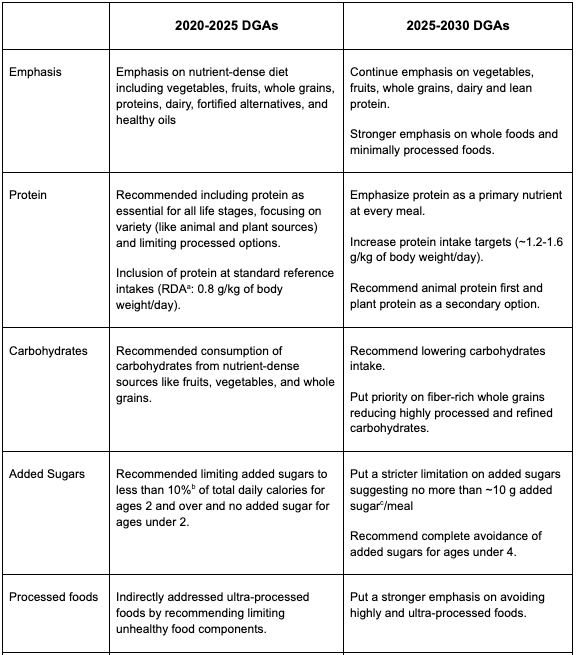
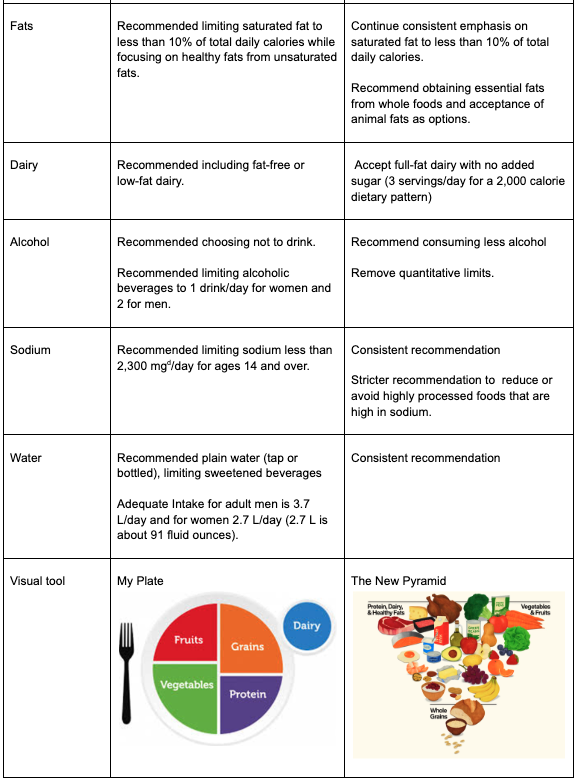
a RDA: Recommended Daily Allowance
b <50 g of added sugar for 2000 calories/day
c 10 g sugar = ~2.25-2.40 teaspoons
d 2,300 mg of sodium + ~ 1 teaspoon
Summary
The 2025-2030 DGAs emphasize consumption of whole foods and protein. It has a stronger emphasis on limiting added sugars and highly processed foods. Despite the previous DGAs’ recommendation of a plant-based diet, the new DGAs have shifted toward accepting both animal protein and fat as well as full-fat dairy. The new guidelines have drawn criticism due to health concerns about increased saturated fat intake. They also removed specific quantity limits on alcohol consumption. The new guideline for alcohol is considered less strict and can cause confusion for consumers.
The bottom line is that the new guidelines are based on ongoing research and their goals are to promote health and prevent chronic disease in the U.S.

Dr. Young Ju is a Ph.D and Associate Professor of Human Nutrition, Foods, and Exercise at Virginia Tech.
References
U.S. Department of Agriculture. “Dietary Guidelines For Americans, 2025-2030” https://cdn.realfood.gov/DGA.pdf
U.S. Department of Agriculture. “Dietary Guidelines For Americans, 2020-2025”https://www.dietaryguidelines.gov/sites/default/files/2020-12/Dietary_Guidelines_for_Americans_2020-2025.pdf
People with any health problems should talk to their healthcare providers. This information is provided for your reference, and you use at your own risk; you should rely on your medical professional for medical advice.